
Focus areas and working groups
The technologies we advance, the sectors where they matter most for Malaysia, and the working groups where members do the work.
Technologies
Focus areas
MEIHA covers the whole stack of intelligent machines, from AI models to the motors that move them.
Embodied AI
AI that learns and reasons through a physical body: perception, manipulation, navigation and interaction with people.
Physical AI
AI systems that understand and act on the physical world, including the simulation, digital twins and world models used to train them.
Humanoid robotics
Robots with a human-like form that can work in spaces built for people: walking, climbing stairs, using tools and handling objects.
Enabling technologies
The components and infrastructure every embodied system depends on, many of which Malaysian industry can supply.
How it works
AI with a body
Embodied intelligence perceives, decides and acts in the physical world. A humanoid robot runs this loop continuously, with low-level joint control cycling hundreds of times per second.
Perception
Sense
Cameras, depth sensors, LiDAR, microphones and tactile skins turn the surroundings into data.
Reasoning
Decide
Foundation models, planners and controllers work out what to do next and how to move safely.
Actuation
Act
Motors, joints, grippers and hands carry out the plan: walking, lifting, assembling, assisting.
Sectors
Application sectors
Aligned with the National Robotics Roadmap's priority sectors of manufacturing, agriculture and services.
- MFG
Manufacturing and E&E
Malaysia is one of the world’s major hubs for semiconductor assembly, test and packaging. Embodied AI can handle high-mix, low-volume work that fixed automation cannot.
- Machine tending and material handling
- Assembly, inspection and rework
- Flexible cells that switch between products
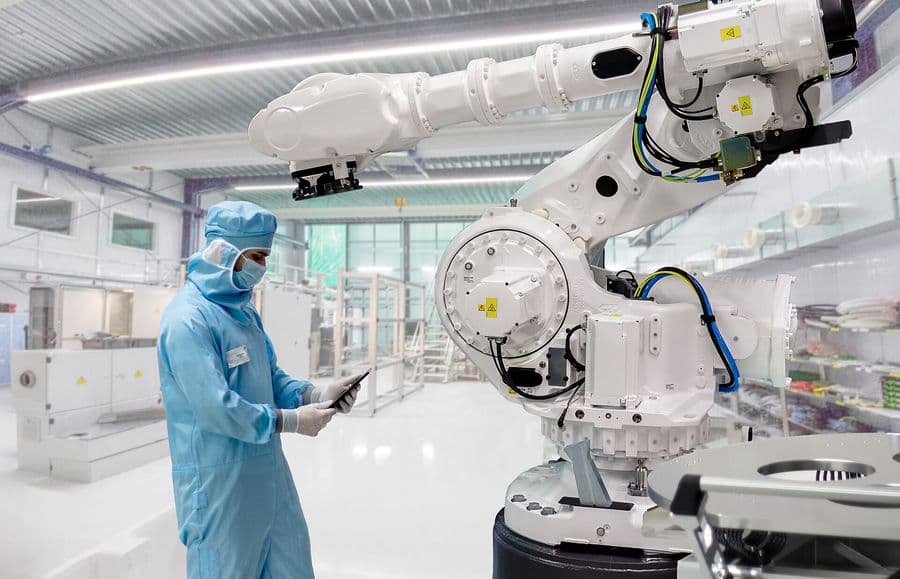
ABB six-axis robot in an ISO Class 6 cleanroomPhoto: Clemenspool, CC0, via Wikimedia Commons - AGR
Agriculture and plantations
Plantations and food processing rely on manual labour that is increasingly hard to find. FELDA and MaGIC are testing harvesting robots in the national sandbox.
- Harvesting and crop monitoring
- Post-harvest handling and packing
- Food processing lines
- HLT
Healthcare and eldercare
Malaysia’s share of people aged 65 and over reached 8.0% in 2025, and care systems need support that scales.
- Patient assistance and mobility support
- Hospital logistics and disinfection
- Companion and assistive robots
- LOG
Logistics and warehousing
E-commerce growth and regional trade raise demand for fast, reliable fulfilment.
- Picking, packing and palletising
- Loading and unloading
- Autonomous mobile manipulation
- SVC
Retail, hospitality and public services
Robots that operate safely in public spaces, alongside staff and customers.
- Guidance and reception
- Stock replenishment and cleaning
- Public sector front-line services
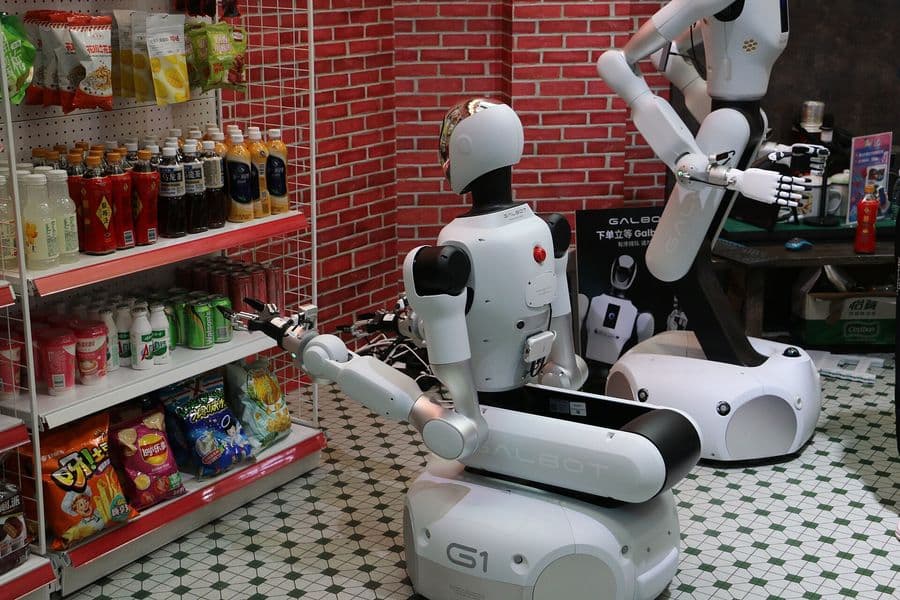
Galbot G1 robots in a retail demonstration at WAIC 2025, ShanghaiPhoto: Xuthoria, CC BY-SA 4.0, via Wikimedia Commons - ENG
Energy, utilities and hazardous inspection
Removing people from dangerous, dirty and remote work.
- Plant and pipeline inspection
- Confined-space and high-risk tasks
- Teleoperated maintenance


Working groups
Member-led working groups
Working groups are where members share knowledge, shape position papers and run projects. Any member can join one or more groups.
Humanoid Platforms & Hardware
Actuators, hands, locomotion, power and the Malaysian supply chain for robot components.
Embodied AI & Software
Foundation models, simulation, data collection, sim-to-real transfer and robot software stacks.
Safety, Standards & Ethics
Industry input on safety standards, interoperability, data governance and ethical deployment.
Industry Adoption & Pilots
End-user needs, use-case libraries, pilot design and return-on-investment evidence.
Talent & Education
Curricula, technical training, certification pathways and student engagement.
Investment & International
Commercialisation, funding access, and collaboration with ASEAN and global partners.